Rethinking Subscriptions in 2025
Subscription Model: A History
The earliest form of the subscription model business originated in the 1600s when newspaper and book publishers began offering subscriptions to their readers. The rise of digital content and software saw the subscription business model gain traction at the turn of the 20th century, with companies like Netflix introducing the digital content subscription models in the 2000s.
The subscription model had become the reigning champion of predictable revenue and customer loyalty by the mid-2010s, with companies clamouring to adopt the monthly subscription model to ensure a steady income source.
Fast forward to 2025, the landscape has changed dramatically, and the once profitable and consistent monthly subscription system is no longer the poster child of pricing models.
The Saturation Point
Monthly subscription plans have hit their saturation point with customers drowning under the sheer volume of monthly bills. Every aspect of a customer’s life, from grocery delivery to fitness apps and streaming services, is run through subscription services. The overwhelming number of subscriptions has compelled customers to push back.
According to a recent survey by Gartner, 62% of consumers said they had canceled at least one subscription in the past year. This trend has led brands to rethink their pricing strategies, exploring new models that better align with evolving customer preferences.
Why Monthly Models are Losing Their Appeal
The monthly subscription model is slowly losing its charm, and here is why:
1.Rising Churn Rates:
The rising number of platforms offering competitive pricing has made it hard for businesses to retain users. The customer-friendly cancellation options are no help either. Even major SaaS platforms like Netflix, which experienced an increase in subscription cancellations due to price hikes, are not immune to the increasing churn rates.
2.Consumer Fatigue:
Most SaaS platforms today are working on the monthly subscription pricing model, making it difficult for users to stay on top of all the payment schedules. Managing multiple subscriptions has become overwhelming, forcing many users to unsubscribe from non-essential services to help better manage their finances and free themselves from the hassle of remembering to pay subscription prices for multiple services.
3.Bundling Backlash:
When first introduced, bundling of services seemed like a great way to reduce the number of subscriptions while providing multiple services, effectively a win-win situation for both the seller and the user. However, with time, the bundling strategy has proven to be ineffective as the bundling offered by sellers does not align with the needs of the user. For instance, Disney+’s decision to bundle Hulu and ESPN backfired as multiple users wanted access only to specific content and not the entire bundle.
New Pricing Strategies Emerging in 2025
With customers turning their backs on monthly subscription models, other pricing strategies have come to the forefront. Some of the new pricing strategies emerging in 2025 are:
1.Pay-Per-Use Models:
Following the backlash surrounding the monthly subscription model, many businesses have switched pricing techniques to suit the users’ needs. To retain users, SaaS platforms are providing users the option to pay for the services based on their usage rather than paying for all the services. Canva and Adobe are two such platforms offering a pay-per-use pricing model.
2.Annual Plans with Discounts:
Another way that SaaS platforms are reducing their churn rates is by introducing annual payment plans. Businesses are offering users a chance to avoid monthly payments by offering annual payment plans at substantial discounts. A win-win for both parties, as the user receives discounted services without worrying about monthly payments, and the business can secure long-term customers with a stable cash flow.
3.Flexible Memberships:
Flexible memberships are gaining traction across various industries, offering users the option to pause and resume services based on their needs without incurring cancellation fees. This model, now widely adopted by gyms and fitness apps, empowers customers to take breaks without losing their membership benefits, making it beneficial for both businesses and users.
Future of Subscription Pricing
2025 has seen subscription models evolve from the one-size-fits-all monthly subscription models to more customized ones based on the customers’ needs. As the subscription landscape evolves, brands that truly succeed will be those that master the delicate balance between steady, predictable revenue and customer-centric flexibility. In 2025, consumers are more discerning, seeking value and control over how they spend their money, while businesses are rethinking how to keep them engaged without compromising profitability. Those that can innovate by offering flexible memberships, pay-as-you-go plans, or curated bundles will be the ones that not only survive but thrive in this new era of subscription.
GasBuddy App Review: Find Cheapest gas in your area
Ever been stuck in traffic or on a road trip with your fuel light blinking—and no clue where the nearest or cheapest gas station is?
It’s one of those stressful moments most drivers have faced, especially when you’re far from familiar roads or watching gas prices climb by the day.
For Everyday commuters, these unpredictable fuel costs can quietly drain your budget. What if there were a way to find the most affordable gas stations nearby, instantly?
That’s where GasBuddy steps in. This powerful yet simple app does the heavy lifting, helping you locate the cheapest fuel in your area in seconds. Whether you’re managing a fleet or just trying to save on your next fill-up, GasBuddy puts control back in your hands.

Quick App Snapshot
- App Name: GasBuddy
- Best For: Commuters, Road Trippers, Fleet Managers, Budget-Conscious Drivers
- Platform: iOS / Android / Web
- Top Feature: Real-Time Gas Price Tracking & Pay with GasBuddy+™ Card
What Is GasBuddy and Why Does It Matter?
GasBuddy is a mobile and web application that helps users locate the most affordable gas prices in their vicinity. By leveraging a vast community of users who report gas prices, GasBuddy provides real-time data to ensure you’re always informed about where to fuel up economically.
For Commuters, especially those managing fleets or delivery services, fuel costs can significantly impact the bottom line. GasBuddy offers tools to monitor fuel expenses, plan cost-effective routes, and ensure that drivers are always refueling at the most economical stations. This not only reduces operational costs but also enhances overall efficiency.
Moreover, GasBuddy’s integration of the Pay with GasBuddy+™ Card allows businesses to streamline fuel payments. This card, accepted at stations nationwide, offers discounts on every gallon, translating to substantial savings over time.
In an era where fuel prices are volatile, having a reliable tool like GasBuddy can be the difference between staying within budget or overspending. Its user-friendly interface and comprehensive features make it an indispensable asset for individual drivers and businesses alike.

Who Is This App REALLY For?
Recommended For:
✅ Daily commuters seeking to reduce fuel expenses.
✅ Road trippers aiming for budget-friendly journeys.
✅ Fleet managers overseeing multiple vehicles.
✅ Delivery services looking to optimize fuel costs.
✅ Budget-conscious individuals tracking fuel expenditures.
Avoid If:
🚫 You reside in areas with limited user participation, leading to outdated price data.
🚫 You’re seeking international fuel price comparisons (GasBuddy primarily covers the U.S. and Canada).
🚫 You prefer not to link your bank account for payment features.
Real Use Case
In a review by The Points Guy, users highlighted the benefits of using the Pay with GasBuddy card, noting savings of up to 25 cents per gallon. One user mentioned that by combining GasBuddy with other cashback apps, they achieved significant savings on fuel. However, some users on Reddit expressed concerns about the accuracy of gas prices in less populated areas, emphasizing the importance of user participation for real-time data.
Key Features
Real-Time Gas Price Tracking
GasBuddy relies on a community-driven approach, where users report gas prices, ensuring up-to-date information. This crowdsourced data allows users to find the cheapest gas stations in their area.
Pay with GasBuddy+™ Card
This feature offers users discounts on every gallon of gas purchased. By linking the card to your checking account, you can save up to 30¢ per gallon at participating stations.
Trip Cost Calculator
Plan your journeys more efficiently by estimating fuel costs based on your route, vehicle type, and current gas prices.
Vehicle Recall Alerts
Stay informed about any recalls related to your vehicle, ensuring safety and compliance.
Rewards and Challenges
Engage in daily challenges and games to earn points, which can be redeemed for gift cards or entered into sweepstakes for free gas.

Some Tips For Using the GasBuddy App
Below are some of the useful tips and tricks that you should definitely know about while using the GasBuddy application:
1. To make your app more effective, add your vehicle directly to the GasBuddy app in order to receive automatic notifications whenever a new recall is issued.
2. Users can even report their gas prices to help other users save some extra money. With this feature, they can also improve their ranks in the support community of the GasBuddy app.
3. GasBuddy allows you to earn additional achievements by completing daily, weekly, and monthly challenges in the mobile application.
4. Users can constantly write reviews and even rate gas stations for their service. Here, they also have an option to include tips for other GasBuddy users.

Pricing Breakdown & ROI for Businesses
Free Version: Access to real-time gas prices, trip cost calculator, and basic rewards.
Pay with GasBuddy+™: Free to join, offering up to 30¢ per gallon savings.
GasBuddy Premium: $9.99/month, guaranteeing at least 20¢ per gallon savings (up to 50 gallons/month), 24-hour roadside assistance, and exclusive GasBack offers.
For businesses, the ROI is evident.
For instance, a fleet consuming 1,000 gallons monthly could save up to $300 with the Pay with GasBuddy+™ card. Over a year, this translates to substantial savings, justifying the premium subscription for larger operations.
Pros and Cons
Pros:
✅ Significant Savings: Potential to save up to 30¢ per gallon.
✅ Community-Driven Data: Ensures real-time, accurate gas prices.
✅ Additional Features: Trip cost calculator, vehicle recall alerts, and rewards system.
✅ User-Friendly Interface: Easy navigation and intuitive design.
Cons:
❌ Data Accuracy: Relies on user submissions; less populated areas may have outdated information.
❌ Bank Account Linking: Some users may be hesitant to link their checking accounts.
❌ Limited International Coverage: Primarily serves the U.S. and Canada.
How It Stacks Up Against Alternatives
Upside
Offers cashback on fuel purchases, but users pay full price upfront and receive rebates later. GasBuddy provides immediate discounts at the pump.
Waze
Primarily a navigation app with gas price features. While Waze offers route optimization, GasBuddy focuses more on fuel savings and related tools.
BPme Rewards
Specific to BP gas stations, offering rewards and discounts. GasBuddy covers a broader range of stations, providing more flexibility.
Final Verdict: Should You Use It or Skip It?
Our Verdict: ⭐️⭐️⭐️⭐️☆
GasBuddy stands out as a valuable tool for both individual drivers and businesses aiming to cut down on fuel expenses. Its community-driven data ensures real-time price tracking, and the Pay with GasBuddy+™ card offers tangible savings.
While there are minor drawbacks, such as reliance on user submissions and the need to link a bank account, the benefits far outweigh the cons.
If you’re looking to make informed decisions at the pump and save money consistently, GasBuddy is a must-have app.
Ready to start saving on fuel? Download GasBuddy today and experience the benefits firsthand.
Need assistance in developing a similar app? Contact Us for expert guidance.
Related Post
What is the GasBuddy App Used For?
The GasBuddy app helps users find the cheapest gas prices nearby, track fuel trends, and earn rewards. It’s widely used by drivers to save money on fuel and make informed decisions when planning trips.
Is the GasBuddy App Free or Paid?
GasBuddy is free to download and use, offering essential features like gas price comparisons and location tracking. The app also offers optional premium features, including enhanced rewards and ad-free experience for a subscription fee.
Is the GasBuddy App Safe and Reliable?
Yes, GasBuddy is safe and reliable. It uses verified user submissions and official data sources to provide accurate gas prices, making it a trusted tool for drivers seeking cost-effective fueling options.
Sam Altman vs. OpenAI Board: A Governance Wake-Up Call
In November 2024, OpenAI’s meteoric rise took a sudden turn when CEO Sam Altman was abruptly ousted by the company’s board of directors – a move that sent shockwaves across the tech landscape. The incident, dubbed the “Altman Saga,” quickly became a flashpoint for broader discussions about leadership accountability, internal revolts, and governance failures within high-growth companies.
The Altman Saga
Sam Altman, known for his ambitious vision of advancing AI capabilities, had been the face of OpenAI’s ascent. Under his leadership, the organization transitioned from a research-oriented non-profit to a formidable commercial enterprise, striking lucrative deals and pushing the boundaries of AI development. Yet, Altman’s ouster exposed underlying governance cracks – a board caught between managing risk and maintaining innovation momentum.
The suddenness of Altman’s removal raised eyebrows. Was it a case of unchecked power? An internal power struggle? Or a cautionary tale of a board overstepping its mandate? In the days that followed, public outcry and employee protests erupted, leading to Altman’s dramatic reinstatement as CEO – but the damage to OpenAI’s credibility had already been done.
Leadership Accountability vs. Innovation Imperatives
The Altman Saga highlights a critical tension in high-growth tech firms: How do you maintain accountability at the leadership level without stifling the very innovation that drives success? For OpenAI, the board’s decision to remove Altman seemed to stem from concerns about strategic direction, potential conflicts, and possibly unchecked influence. But in its haste to act, the board underestimated Altman’s sway within the organization and the broader AI community.
Leadership accountability is crucial, but in companies like OpenAI – where visionaries often hold disproportionate power – removing a charismatic leader can lead to chaos. For OpenAI, the backlash underscored how much the brand was intertwined with Altman’s identity and vision.
When Internal Revolts Go Public
What was perhaps most striking about the Altman episode was how quickly internal dissent spilled into the public sphere. Employees took to social media, expressing their discontent with the board’s decision and effectively launching a digital revolt. The incident demonstrated how rapidly internal governance disputes can escalate, especially in an era where tech employees are more empowered and vocal than ever before.
For companies, the lesson is clear: Internal governance issues are no longer just boardroom matters – they can quickly become PR crises if not managed with transparency and tact.
The Governance Gap in High-Growth Companies
OpenAI’s governance crisis is not unique. Fast-growing tech firms often struggle to balance rapid innovation with robust governance structures. When decision-making power is concentrated in the hands of a few, accountability mechanisms can become weak or non-existent. The Altman Saga is a cautionary tale of what happens when governance mechanisms lag behind operational complexity.
Protecting Your Company from Founder Fallout
For companies navigating similar dynamics, there are key takeaways:
- Establish Clear Governance Protocols: Define the board’s authority and outline clear guidelines for executive removal to prevent chaotic power struggles.
- Regularly Assess Leadership Performance: Implement performance reviews that balance innovation with ethical considerations and strategic direction.
- Empower Internal Whistleblowing: Ensure that employees can voice concerns internally without resorting to public dissent, mitigating reputational damage.
- Separate Founder Influence from Brand Identity: Create a strong, independent brand identity that is not overly reliant on a single leader, preventing crises when leadership changes occur.
The Road Ahead for OpenAI
Despite the confusion, OpenAI remains a dominant force in the AI space. The question now is whether it can rebuild trust, strengthen its governance framework, and maintain its innovative edge without being held hostage by internal power dynamics.
For other companies, the lesson is clear: In the race to innovate, governance cannot be an afterthought – it must be as agile, adaptable, and forward-thinking as the tech being developed.
Is governance important? Share your thoughts in the comment section below.
For Reviews on all things business, visit Ikana Business Review.
Skiplagged App Review: Best App for Booking Cheap Flights in 2025

You’re a startup founder heading to a pitch event in San Francisco, but the direct flights from New York are way out of budget. You check Google Flights and Expedia, and you even try incognito mode, but nothing drops below $500. Frustrated, you think, “Is this really the cheapest option?”
That’s where Skiplagged sneaks in and surprises you. What if you could fly to San Francisco for half the price, simply by booking a ticket to another city and getting off midway?
Sounds crazy? That’s the loophole Skiplagged is built on.
Quick App Snapshot
App Name: Skiplagged
Best For: Budget travelers, Startup founders, Solo business professionals
Platform: iOS / Android / Web
Top Feature: Hidden-city ticketing (a legal flight hack that finds cheaper routes)
What Is Skiplagged and Why Does It Matter?
Skiplagged is a travel booking app and website that helps users find unusually cheap airfare using a strategy called hidden-city ticketing.
For budget-conscious startups, solo entrepreneurs attending conferences, or marketing heads planning roadshows, this app offers significant savings that can add up fast. When every dollar counts, cutting travel costs by 30–50% can mean reallocating that budget to marketing campaigns, product trials, or talent hiring.

The term “Skiplagging” is quite common nowadays. It’s a technique that allows people to save on-air tickets by booking the tickets for the destination where the flyer wishes to go. With Skiplagging, the business class tickets can even get cheaper than the economy class.
Skiplagged reviews the flights that are headed towards the chosen destination and among all, the flights which have a stop on the destination are picked up by the app, as they are cheaper.
Who Is This App REALLY For?
Recommended For:
✅ Startup founders traveling on lean budgets
✅ Marketing professionals attending events or conferences
✅ Freelancers hopping cities for client work
✅ Solo travelers and digital nomads
✅ Cost-conscious small business teams
Avoid If:
🚫 You’re checking bags (hidden-city ticketing only works with carry-ons)
🚫 You require flexible, refundable flights
🚫 You fly frequently with loyalty programs (airlines might void miles)
🚫 You’re traveling internationally with immigration or visa checks at your final destination
Our Hands-On Experience / Real Use Case
We tested Skiplagged for a founder attending TechCrunch Disrupt in San Francisco. Traditional flights from Chicago were pricing around $420 round trip. Skiplagged revealed a hidden-city ticket to Oakland with a layover in San Francisco—for $189.
The founder booked the ticket, brought a carry-on, skipped the final leg, and saved over $230. The process was seamless. Booking took under 10 minutes. The app even provided hotel suggestions nearby.
Surprising bonus? The app sends real-time flight alerts and reminders, making it functional beyond just ticket discovery. There were no additional fees from Skiplagged, unlike other platforms that sometimes sneak in service charges.
Key Features
Take a look at the key features of Skiplagged which makes it one of the best last-minute flight applications, these features will give you an overview of how this flight ticket booking app works:
1. Heavily discounted flights
2. Innovative search bar to ease the exploration
3. Booking links are available within the app.
4. Automatically generated destination list
5. List of extensive cities
6. Ease of changing the default currency

Skiplagged App Guidelines
The Skiplagged app has some rules, which are a kind of unsaid directions that need to be followed to keep using this app. And if the rules are taken lightly, the flyer may find himself in a tight spot.
Therefore, it’s wise to stick to the rules. Here are the Skiplagging guidelines:
- Don’t disclose to anyone that you are skipping a flight;
- Skiplagging is not for the round trip;
- Flight missing is a big no-no;
- Luggage can’t be checked-in, it will carry on to the final destination.
- Skiplagging is not a privilege, so don’t abuse it.
Pricing Breakdown & ROI for Businesses
Skiplagged is free to use. There’s no membership fee or booking surcharge from the platform itself. You only pay the airline or hotel provider directly.
ROI for Businesses:
- Save 30%–50% on flight costs
- Reduces the need for premium travel planning services
For example, if your team travels twice a month and saves $150 per trip, that’s over $3,600/year in savings.
Pros and Cons of Skiplagged
Pros:
✅ Massive savings on airfare using hidden-city trick
✅ Free to use
✅ Clean UI and mobile-friendly
✅ Hotel search included
✅ Alerts for fare changes
Cons:
❌ Doesn’t work with checked baggage
❌ Airlines may penalize frequent use
❌ Not ideal for international multi-leg trips
❌ No integrations with business tools
What Makes Skiplagged Stand Out?
1. Extreme Discounts: The deals on the Skiplagged flights app are incredible and due to their popularity among the masses, the app has been featured on platforms like CNN, the BBC, and the Los Angeles Times. As said before, business class tickets can be availed at a much lesser price than they are quoted by the airlines.
2. Search With Ease: With a built-in search bar and a host of other filters, the user can set his own criteria to find the preferred flights. For greater ease, the Skiplagged app automatically fills in the closest major airport and the user just needs to enter the destination city. With all this data, the app comes up with all the flights headed over that destination and also lists those flights which have the same stop as the destination.
3. Suggested Cities: Skiplagged displays a list of cities where users can travel and the discounted tickets that can be availed. The suggested list includes travel destinations too. So, the Skiplagged application is one of the best travel apps out there that can also be used as a travel planner.
4. Ease of Ticket Booking: Select the destination where you wish to visit and Skiplagged will display all the details including the airline, departure dates, and any stopovers. To book a ticket, the user will be directed to a website where it can be done without much mess.
5. Deal In Preferred Currency: The default currency in which the user can deal in Skiplagged is US dollars, but the currency can be changed, as the app has a list of available currencies.

Other Highlights Of Skiplagged
Skiplagged is not just about cheap flights and reasonable flight booking; the best flight ticket app also offers hotel reservations that come packed with last minute hotel deals, online hotel bookings, and more.
After traveling to a different city, the traveler needs to find a place to rest, so to cater to this need, the Skiplagged app also offers cheap hotel deals, which again can help the user to save money. This is also one of the reasons why it is considered for
For hotel deals, here are the options that can be availed:
1. Book hotels
2. Cheap last-minute hotels
3. Online hotel booking
4. Best hotel deals
5. Filter hotels, read Skiplagged reviews, and view traveler ratings
How It Stacks Up Against Alternatives
Google Flights:
Google Flights shows pricing from multiple sources and fare calendars. But it doesn’t surface hidden-city deals. Skiplagged offers better prices, not just more options.
Hopper:
Hopper predicts fare trends and suggests the best time to book. While good for forecasting, it lacks the kind of loophole pricing Skiplagged uncovers.
Expedia:
Expedia is a generalist. Skiplagged wins in niche use, finding loophole savings that Expedia doesn’t even show.
Final Verdict: Should You Use It or Skip It?
Our Verdict: ⭐️⭐️⭐️⭐️⭐️
Skiplagged is a must-have tool for scrappy business travelers. If you’re a founder, freelancer, or marketer attending events, meeting clients, or doing city hops, it can be your best-kept secret to slashing travel budgets.
If you run a startup and want to travel smart without breaking the bank, Skiplagged is a no-brainer.
Try Skiplagged for your next business trip and save your startup budget where it matters most.
👉 Looking for more business travel tools? Check out our review of the CamScanner PDF App for Startups to digitize all your travel receipts on the go.
Need help creating an app or business tool like this?
Contact Us — we build MVPs, websites, and tech solutions for founders.
What is the Skiplagged App Used For?
The Skiplagged app is a travel booking tool that helps users find hidden-city flights and discounted hotel deals. It shows unique flight options that are often cheaper than traditional booking sites, making it popular among budget travelers.
Is Skiplagged App Legit and Safe to Use?
Yes, the Skiplagged app is legit and safe. It has been featured in major media outlets for exposing cheaper travel options. However, users should check airline policies, as some carriers may not allow hidden-city ticketing.
Does Skiplagged Really Save Money on Flights?
Absolutely. Skiplagged is known for finding flight hacks that can save travelers hundreds of dollars. By showing unconventional routes and hidden-city fares, the app helps users book the most affordable travel options available.
Operation Sindoor: How a Name Can Shape a Legacy
Introduction
What’s in a name?
Well, for a brand-everything!
A name is not just a label- it’s a strategic tool. It is the first introduction of a brand to its customers. It is a brand’s way of creating a perception, a brand story, and an identity. A well-chosen name sets the stage for the brand experience. It is what customers remember and associate with their overall brand experience.
A name is not just about recognition; it’s the narrative behind a brand’s origin and a powerful spotlight that illuminates its core values. For instance, the name of Apple has become synonymous with quality, innovation, and trust. Similarly, the name Tesla, named after the inventor Nikola Tesla, suggests cutting-edge technology and a bold, visionary approach.
While a well-chosen name may enhance a brand’s value, a poorly chosen one, like Hitler Chicken, can lead to confusion and even controversy. It’s not just the brand name itself—names associated with a brand can significantly impact its value, as seen in the Yeezy-Adidas fallout from being too closely linked to the unpredictable Kanye West.
This Review delves into the strategic importance of a brand name through the lens of ‘Operation Sindoor’, the recent military operation undertaken by the Indian Army.
Operation Sindoor
The Indian Army’s missile strikes on Pakistan in response to the Pahalgam attack on 22 April 2025 are a powerful example of how a name can shape perceptions, drive narratives, and evoke emotions.
The Indian Military intervention gained worldwide attention not just for the mission itself but also for the culturally resonant codename- Operation Sindoor. Rooted in the Sanskrit word Sindura, Sindoor—the sacred red powder worn by married Hindu women as a symbol of their marital status and their husbands’ long life—immediately evoked a deep, cultural connection to Indian traditions and was interpreted as a name for vengeance for the women widowed in the Pahalgam attack.
Incorporating the operation’s vision of avenging the death of 26 innocent men in the very name of the mission was a masterstroke in branding and a testament to the power of a name.
But why is a name a powerful strategic tool?
What’s in a name?
Operation Sindoor is a testament to what a well-chosen name can do for a brand. Here is why choosing the right name matters:
1. Purpose:
A name can help communicate the purpose, core values, and image that the brand is trying to project. Just like Operation Sindoor, which clearly illustrated the operation’s focus on Indian culture, women, and protection, a well-chosen name can be a brand’s way to communicate its vision with its audience.
2. Emotions:
The right name can help elicit emotions. Operation Sindoor, for instance, used a term that resonated with millions of Indians as it reminded them of their culture and the loss suffered by the widows of the Pahalgam attack. A name that tugs at the audience’s emotions makes for a more impactful and relatable brand.
3. Memorability:
A name that resonates with the audience has a strong recall value. Like Operation Sindoor, a name that is easy to remember, has a significant meaning, and aligns with the brand’s core values, can leave a lasting impression on the brand’s audience.
4. Brand Positioning:
Ifthe buzz created by the name Operation Sindoor is any indication, a well-chosen name can help reflect the personality and positioning of the brand. Just like Operation Sindoor helped position the Indian military action as a retribution for unprovoked bloodshed, a name reflecting a brand’s core values can help it attain the right market positioning and attract the attention of the target audience.
Lessons from Operation Sindoor
The resounding success of Operation Sindoor is a glowing testament to the power of choosing a name that resonates with the audience’s emotions and aligns with the brand’s vision. It reflects how the correct name can foster a sense of relatability with the brand and project a powerful brand message.
What Worked and What Didn’t
Here are some examples of brand names that worked and that didn’t:
1. Apple:
Who hasn’t heard of the tech giant Apple? The name that personifies technology is a masterstroke in branding. It stood out from its contemporaries in the 1970s for its simplicity and approachability. Chosen because Jobs was on one of his fruitarian diets and having visited an apple farm, thought the name sounded “fun, spirited and not intimidating”, the name turned out to be a hit. The choice proved to be a masterstroke for several reasons: its simplicity and approachability, its connection with Jobs’s fondness for apples, and the strategic advantage in alphabetical listings in phone books and directories.
The Lesson: When choosing a name, make sure it is simple and easy to remember. An uncomplicated brand name has more recall value and is more likely to linger in customers’ minds.
2. Nike:
Another name that is a shining example of branding genius is Nike. The Nike name won the branding race because, unlike other generic names, it’s unique and timeless. Named after Nike, the Greek goddess of victory, the name conveys strength and success, qualities that are embodied by the brand and its mission to inspire athletes to push their limits.
The Lesson: When choosing a name, brands must aim for one that is not only distinctive but also reflects the brand’s core values. The name should have the ability to resonate emotionally with its customers.
3. Pee Cola:
The debacle that was Pepsi’s ‘Pee Cola’ can be a cautionary tale for brands seeking a suitable name. Pepsi marketed a soda named ‘Pee Cola’ in Ghana, and though ‘Pee Cola’ in Ghana means ‘very good cola’, Pepsi failed to recognize the connotations the name may have in English-speaking markets.
The Lesson: When choosing a name for your brand, especially if you are targeting a global audience, research the alternate meanings the name may have in other languages to avoid unfortunate mistakes.
4. Qwikster:
Not many have heard of Qwikster, Netflix’s brief stint at preserving its DVD rental business in 2011. Chosen to represent the quick delivery of DVDs by the brand, the name failed to achieve its objective. The name, though great in itself, failed to align with the brand’s vision and received public backlash as it did not sound like a DVD-by-mail service.
The Lesson: When choosing a name for your brand, ensure that it aligns with your brand’s business. The audience should be able to associate the brand name with the goods or services being provided.
Takeaway
A name is a brand’s identity- an embodiment of what it stands for, its mission, and core values. It plays a powerful role in shaping a brand’s legacy. While the right name can elevate a brand, the wrong one can undermine its impact. However, the challenge does not end at picking the right name but in consistently living up to what that name represents. Because at the end of the day, a name is more than just a label—it’s the story, the promise, and the legacy a brand carries forward.
Which brand names missed their mark? Share your opinion in the comments section below.
To read more Reviews about branding and marketing, visit Ikana Business Review.
Obviously AI review: No-Code Predictive Analytics Made Simple in 2025.
Imagine you’re sitting on a goldmine of customer data—emails, sales records, support tickets—but you’re not a data scientist. You don’t code, and the thought of diving into Python or hiring a team to build models makes your head spin.
What if you could predict churn, sales, or campaign success using just plain English… in under 5 minutes?
That’s where Obviously AI steps in. It promises to make predictive analytics radically simple—no code, no math PhD needed.
Quick App Snapshot
| App Name | Obviously AI |
| Best For | SaaS startups, eCommerce founders, marketing teams, business analysts |
| Platform | Web |
| Pricing | Free trial + Paid Tiers (starts at $75/mo) |
| Top Feature | No-code predictive analytics with natural language queries |
What Is Obviously AI and Why Does It Matter?
Obviously AI is a no-code predictive analytics tool built specifically for non-technical teams. It allows users to upload datasets (like Excel or CSV files), ask questions in natural language, and get AI-generated predictions instantly, without writing a single line of code.
For example, a founder can ask, “Which customers are most likely to churn next month?” or “How will marketing spend affect next quarter’s sales?” Obviously AI will build and run a machine learning model to answer it.
It fills a critical gap for small and medium businesses that can’t afford full-time data scientists, but still want actionable insights from their data to make smarter decisions.
Who Is This App REALLY For?
Perfect For:
✅ Startup founders with no data science background
✅ Marketing teams wanting to predict campaign outcomes
✅ eCommerce managers are optimizing customer retention
✅ Product managers looking for data-backed prioritization
✅ Analysts who want to speed up modeling without code
Not Great For:
🚫 Hardcore data scientists who prefer full control over model parameters
🚫 Teams with highly sensitive data that can’t be uploaded to cloud services
🚫 Businesses expecting deep integrations into enterprise-grade data lakes or tools
Our Hands-On Experience
We tested Obviously AI with a small dataset of 1,000 past sales records from a fictional SaaS company. Our goal was to predict which users were most likely to upgrade to a paid plan within the next 30 days.
Here’s what we observed:
- Uploading the CSV file took less than a minute.
- We used the query: “Predict if user will upgrade based on usage time, login frequency, and last email response.”
- Obviously AI instantly processed the data and generated a decision tree model with over 85% accuracy.
- It even provided a confidence score, feature importance ranking, and downloadable predictions list.
[Imagine a screenshot of feature importance showing “login frequency” as the most important predictor.]
From question to prediction, the entire process took under 10 minutes. For a non-technical founder, this was a game-changer.
Key Features That Stand Out
1. No-Code Model Building: Create machine learning models using an easy-to-use interface, so you don’t need programming skills.
2. Rapid Model Generation: Build predictive models in minutes, cutting down the usual time needed for model development.
3. Integration with Various Data Sources: Easily connect with spreadsheets, databases, CRM systems, and everyday applications to import data smoothly.
4. Automated Machine Learning (AutoML): Use automated processes to choose the best algorithms and adjust settings, improving model performance without manual work.
5. Real-Time Predictions: Deploy models to make real-time predictions, allowing for immediate insights and data-driven decisions.
6. Comprehensive Analytics Dashboard: Get access to detailed analytics and performance metrics to check model accuracy and effectiveness.
Workflow Fit & Integration Potential
Obviously AI is designed for simplicity. It doesn’t require complex data pipelines or engineering support. That said, it integrates with:
Google Sheets
Airtable
Zapier
HubSpot (via API)
REST API for custom integrations
This makes it easy to fit into workflows like:
- Marketing CRMs → Predict lead conversions
- Sales spreadsheets → Forecast monthly revenue
- Support logs → Predict churn or escalation
Ideal Tech Stack: Obviously AI + Google Sheets + Zapier + Notion
Pricing Breakdown
| Plan | Price (2025) | Features |
| Free Trial | $0 | Limited queries & small data sets |
| Starter | $75/mo | Up to 10K records, 10 predictions/mo |
| Premium | $195/mo | 100K records, auto-updating models |
| Custom | Custom pricing | Enterprise integrations & SLAs |
Pros and Cons of Obviously AI
| ✅ Pros | ❌ Cons |
| Super intuitive, even for non-tech users | Limited control for data science professionals |
| Affordable pricing tiers | Lacks deep integrations for enterprise use |
| Natural language queries | May oversimplify complex modeling cases |
| Good accuracy for most SMB use cases | Datasets over 100K rows require custom plans |
| Feature importance & visual insights | Not suited for unstructured data (e.g., text/audio) |
How It Stacks Up Against Alternatives
| MonkeyLearn | Better for text analysis, but less predictive focus |
| DataRobot | More powerful but expensive and complex |
| Pecan.ai | Similar no-code approach, but pricier and less intuitive |
Obviously AI stands out as the most accessible solution for small businesses that want plug-and-play predictive modeling.
IBR’s Verdict: Should You Use It or Skip It?
Our Verdict: ⭐️⭐️⭐️⭐️☆
Use it if you’re a startup or SMB that needs to make smarter decisions from your data—without hiring a data science team.
Skip it if you already have a technical data team or need highly customized, complex models.
It’s not for everyone, but for founders who need insights today—not in three weeks—it’s a powerful, affordable tool.
Want to know whether your customers will churn? Or which leads are worth following up?
Try out Obviously AI with your real data—no code, no jargon.
Need help choosing tools like this for your business? Talk to our team at Ikanabusinessreview.com
Can a Brand Survive Its Creator- Ye or Nay?
Introduction
If Kylie Cosmetics and Fenty Beauty are any indication, having a celebrity at the helm can be a powerful formula for instant brand recognition and built-in loyalty. With a star-powered founder, brands not only gain a competitive edge but also tap into a ready-made customer base fueled by the celebrity’s fan following.
But what happens to the brand when the celebrity’s name is shrouded in controversy?
This Review attempts to break down how celebrity controversies impact brands through the lens of the recent controversy surrounding Kanye West – or Ye, as he now goes by – and his brand Yeezy.
Ye, Yeezy and Adidas
Who doesn’t remember the unstoppable force that was Yeezy with Kanye West at its helm? With a multi-billion-dollar collaboration with the athletic apparel and footwear giant Adidas, Yeezy set up new milestones in the crossover of sneaker culture, streetwear, and luxury, with Forbes describing Yeezy’s rise as “one of the great retail stories of the century”.
However, 2022 saw the end of the highly lucrative collaboration. As the controversies surrounding Ye piled up after a series of inflammatory and antisemitic remarks by Ye, Yeezy’s brand value took a hit, and had Adidas scurrying for redemption by terminating its lucrative partnership with the rapper, a move that cost the brand an estimated $1.3 billion in unsold Yeezy inventory.
The Adidas-Yeezy fallout has been one of the most high-profile business controversies in recent history, highlighting the risks of celebrity brand collaborations. While initially the collaboration earned billions for Adidas, Ye’s increasingly erratic behaviour turned it into a liability overnight.
With billions locked in unsold Yeezy merchandise, Adidas had to manage its financial losses while protecting its brand image. The subsequent sale of the Yeezy inventory and donation of the proceeds to charity, while not enough to completely recover from the aftermath of the controversy, helped Adidas make a clean break from Ye’s controversial statements.
This controversy is a stark reminder of the volatility of celebrity partnerships. While celebrity partnerships can catapult a brand to new heights, they can also be a curse, and here is why…
When the Celebrity Becomes the Brand
Founders often infuse their personality into the brand, blurring the lines between them and making them almost inseparable—think Elon Musk and Tesla or Steve Jobs and Apple. While this integration may help boost the brand’s image when the founder is revered, it can also plummet a brand if the founder’s image takes a hit.
Ye’s shift from a celebrated musician to a controversial figure is a clear example of how a brand’s association with a controversial founder can shift customer loyalty and make customers abandon a brand.
The Fallout Effect
Having polarizing celebrities like Ye be the voice of a brand, even their own, can be the wrong strategic move. When brand and founder identities are tied up, the brand inexplicably suffers from the ripple effects of the founder’s actions.
The Adidas-Yeezy fallout is a vivid illustration of the effect of a toxic founder on brand value. Adidas’s ties with Yeezy and the subsequent fallout due to Ye’s controversial statements led to huge monetary losses and left a lasting stain on the brand’s reputation. The ripples of the Ye controversies could be felt long after the fallout, with Adidas facing the daunting challenge of repositioning itself while grappling with unsold Yeezy merchandise and unsettling questions: Would the products sell without Ye’s endorsement? Would consumers still desire them, or would they now be tainted by controversy?
How to Protect Your Brand from Founder Fallout
Despite being the brand’s creators, the founders must work on creating a separate identity for the brand to ensure its long-term success. Here is what can be done to protect the brand from founder fallout:
1. Diversify:
Create a brand voice independent form the founder. Do not let any one person, even the founder, be the face and voice of the brand. Hire brand ambassadors, evangelists, and influencers to promote your brand to avoid brand dilution due to controversies surrounding a single person.
2. Separation:
Establish clear boundaries between the founder and the brand. The marketing and promotion of the brand must reinforce the demarcation between the brand and the founder.
3. Ethical Standards:
A brand must have clear ethical standards and value systems in place to guide its actions and messaging. The ethical standards help guide the brand’s messaging and core values, thus making it easier to handle problematic founder behavior without losing customer loyalty and diluting brand value.
4. Crisis Management Plan:
A well-thought-out crisis management plan can go a long way in preventing brand value dilution when faced with controversies arising from a founder’s missteps. A crisis management plan veers the brand away from the controversy and towards timely brand rehabilitation.
Can a Brand Fully Recover?
Recovering from a controversy, while not impossible, does take time, and not every brand makes it through unscathed. Some companies with strong goodwill manage to rebound, while others struggle to regain lost ground. The fallout from Kanye West’s Yeezy controversy offers a prime example, with a market giant like Adidas still struggling to recover the market share it lost in the aftermath.
The survival of a brand battling its founder’s controversy hinges on how swiftly it distances itself, pivots, and rebuilds trust with its customers. Uber’s brand overhaul and comeback after the Travis Kalanick era is proof that with the right strategy, a brand can rise from the ashes like a phoenix.
Do you think Yeezy will bounce back from Ye’s controversies and command brand loyalty? Share your thoughts in the comment section below.
For more such Reviews visit Ikana Business Review.
The Vatican’s 2,000-Year Branding Blueprint
Introduction
The early 2000s saw a rise in the now-popular startup culture, and in the two decades since, the world has witnessed multiple startups rise and fall. In the volatile business environment where even household names like Kodak and Blackberry have struggled and failed to hold their market position, one entity has successfully retained its relevance for thousands of years – the Vatican.
The branding genius of the Vatican is not just about religion and faith, but encompasses much more.
This Review sheds light on how the Vatican has masterfully branded itself in a way that has commanded loyalty and authority across generations while remaining rooted in faith and what brands can learn from the branding genius of the Vatican.
1. Brand Consistency
The Vatican has, through thousands of years, been unwavering in its core doctrine anchored in Christ, the church, and unwavering moral principles. The unchanging messaging and the firmness of the belief system have helped the Vatican build trust over centuries and created the unshakeable Vatican brand.
What Brands can learn: Consistency in core values isn’t about resisting change—it’s about evolving without losing your essence. Brands like Dove have beautifully adapted to change while staying true to their core values.
2. Symbolism That Transcends Generations
From the Papal tiara to the keys of Saint Peter, the Vatican thrives on deep visual and ritualistic symbolism. These icons are not just relics—they are daily reinforcements of identity, lineage, and power.
What brands can learn: A strong visual identity—logos, uniforms, even packaging—can act as a subconscious connector across decades. Look at how brands like Nike or Apple have turned symbols into modern sacred signs.
3. Global Localization
Catholicism is practiced in every corner of the globe, yet the message is carefully localized—through language, culture, and rituals—while staying true to the Vatican’s central vision. From Mass in Latin to local dialects, the Church balances global unity with local relevance.
What brands can learn: Legacy companies must embrace glocalization—a global brand voice with local nuance. McDonald’s, for instance, serves paneer burgers in India while keeping its global branding intact.
4. The Power of Storytelling: Scripture, Saints, and Sacrifice
The Vatican excels at storytelling—parables, saints’ lives, martyrdom, and miracles. These stories foster emotional resonance, embody values, and pass down legacy.
What brands can learn: Stories endure more than slogans. Your brand’s journey, customer success stories, or even origin myths can forge powerful connections. Patagonia’s environmental activism or Airbnb’s “Belong Anywhere” campaign do just that.
5. Authority Through Structure and Succession
The Vatican’s structure—from the Pope to cardinals—exudes hierarchical stability. Succession is not disruptive but celebrated as continuity. This institutional memory adds gravitas and endurance.
What brands can learn: Companies with clear leadership transitions and strong internal culture project stability. Disney, despite multiple CEO changes, keeps its magic alive through structured leadership and culture.
6. Ritual as Retention: Habitual Brand Interaction
The Church creates ritual: weekly mass, confession, sacraments. These consistent, repeated actions build habit and, over time, loyalty.
What brands can learn: Create recurring engagement. Whether it’s Apple’s keynote events, Starbucks rewards, or a daily meditation app reminder, rituals keep your audience coming back and deepen emotional ties.
7. Crisis Management with Grace and Gravitas
From the Reformation to modern scandals, the Vatican has weathered multiple crises. Its strategy often includes a mix of humility, reform, and reaffirmation of its higher purpose.
What brands can learn: In times of crisis, legacy brands must acknowledge, adapt, and reaffirm. Transparency, a strong apology, and a return to core values can restore trust. Johnson & Johnson’s Tylenol recall is a textbook example.
8. Timeless Yet Contemporary: Adapting Without Dilution
The Vatican may seem ancient, but it’s on Twitter (@Pontifex), issues environmental encyclicals, and even hosts youth digital synods. It evolves—slowly but surely—without surrendering its essence.
What brands can learn: Modernize your expression, not your essence. Use modern platforms, tools, and language, but stay rooted. Think of how LEGO integrates digital play but sticks to the block.
Conclusion
The Vatican’s brand has stood the test of time by rising above the trends and creating something timeless. By staying rooted to its core values and rituals, the Vatican continues to demonstrate that a brand’s true power lies not in marketing itself but in cultivating profound meaning.
To emulate the Vatican’s branding success, businesses must grasp the value of reinforcing their core identity rather than chasing every new trend. By evolving without compromising their essence, legacy brands can aspire to endure across generations, much like the Vatican.
What do you think of the Vatican’s branding strategy? Share your thoughts in the comment section below. For more such Reviews visit Ikana Business Review.
Cider Clothing Review – A Stylish Gamble or Fashion Goldmine?
The social media-driven fashion revolution has transformed how we discover and shop for clothes. Among the countless Instagram boutiques that have popped up in recent years, one name keeps surfacing in fashion TikToks and Pinterest boards alike: Cider. With its aesthetic appeal and budget-friendly price tags, this brand has captured the attention of style-conscious shoppers worldwide.
But does the reality match the perfectly curated Instagram grid? This comprehensive Cider clothing review dives deep into what you can actually expect when ordering from this viral sensation. Based on first-hand experiences and extensive research across customer feedback, we’ll cover everything from quality and fit to shipping and sustainability – helping you decide if Cider deserves a spot in your wardrobe or should remain just another scrolling temptation.
Whether you’re already eyeing a cart full of their Y2K-inspired pieces or just curious about what the hype is all about, this Cider clothing review will provide the honest guidance you need before hitting that checkout button.
What is Cider Clothing?
Founded in 2020 during the height of the pandemic, Cider quickly positioned itself as a digitally native fashion brand with an aesthetic that speaks directly to Gen Z and young millennial shoppers. Unlike traditional retailers with seasonal collections, Cider operates on a constantly refreshed inventory model, dropping new styles weekly to keep pace with rapidly evolving social media trends.
At the core of their business model is what they call “smart fashion” – a production approach that claims to minimize waste by producing items in small batches based on demand rather than mass-producing inventory that might end up unsold. This Cider clothing review notes that this approach allows them to test styles with their audience while theoretically reducing environmental impact.
The brand’s aesthetic spans multiple trending categories – from cottagecore dresses and Y2K-inspired crop tops to vintage-looking knitwear and statement accessories. With price points typically ranging from $10-$50, Cider occupies that sweet spot between ultra-fast fashion retailers like Shein and more established brands like Zara or H&M.
Without physical stores, Cider has built its presence entirely through digital marketing, particularly through Instagram and TikTok where customer try-on videos and styling content have created organic momentum for the brand.
First Impressions – Shopping Experience
Your journey with any online retailer begins well before the package arrives, so this Cider clothing review starts by examining the digital shopping experience. The Cider website strikes an immediate impression with its clean, visually appealing interface that feels both modern and intuitive. Product photography maintains consistency with bright, clear images that showcase details without feeling overly edited – a refreshing departure from some online retailers.
What stands out most about browsing Cider is their unique categorization system. Rather than simply organizing by traditional categories like “tops” or “dresses,” Cider arranges collections by aesthetic vibes: “Cottagecore Dreams,” “Y2K Revival,” or “French Girl Summer.” This approach feels tailor-made for the social media generation that shops by mood board rather than necessity.
Website Navigation
The mobile experience deserves particular praise in this Cider clothing review – with a responsive design that makes scrolling through endless options surprisingly pleasant rather than overwhelming. The filtering system allows you to narrow by size, color, and price point effectively, though some categories could benefit from more specific fit filters like length or rise height for pants.
The checkout process offers standard payment options including credit cards, PayPal, and increasingly, buy-now-pay-later services like Afterpay and Klarna – appealing to their younger demographic. First-time shoppers are immediately greeted with pop-up discount offers, typically 10-15% off in exchange for an email subscription.
One of Cider’s smartest marketing tactics revealed during this review process is their integration of user-generated content directly into product pages. Scrolling through an item listing reveals a gallery of real customers wearing the pieces, providing valuable context about how garments look beyond professional model shots.
Product Quality – Does It Match the Hype?
Perhaps the most critical section of any Cider clothing review centers on the actual quality of the garments – an area where online-only retailers often face the most scrutiny. After examining multiple items across different categories, the verdict on quality can best be described as variable but generally aligned with the price point.
Fabrics and Materials
Cider’s product descriptions typically disclose fabric composition, with polyester and polyester blends dominating their selections – unsurprising at this price range. Cotton items do appear in the collection, particularly for basic tees and some denim pieces, though often blended with synthetic materials for stretch.
The hand-feel of fabrics varies significantly by item type. Knitwear tends to perform surprisingly well, with sweaters offering decent weight and comfort despite their affordable pricing. Summer dresses and blouses often feature thinner materials that, while appropriate for warm weather, sometimes reveal a quality difference compared to higher-end retailers.
Construction Details
Examining construction details provides further insights in this Cider clothing review. Stitching generally holds up through initial wears and washes, though inconsistencies can appear along seams in more complex garments. Buttons, zippers, and other hardware tend to be functional rather than premium, occasionally showing finishing issues like loose threads or uneven application.
When compared to similar-priced competitors, Cider tends to outperform ultra-budget brands like Shein in construction quality but doesn’t quite match the consistency of Zara or H&M, who benefit from decades of supply chain refinement.
Expectations vs. Reality
The gap between website photos and delivered items – a common concern with online shopping – is relatively narrow with Cider. Colors generally match product images accurately, and silhouettes largely deliver what’s promised. Where discrepancies do occur, they typically involve fabric texture or small design details rather than dramatic differences in overall appearance.
Sizing & Fit – True to Size or Hit-and-Miss?
Any thorough Cider clothing review must address what is perhaps the most challenging aspect of online fashion: sizing consistency. Cider offers sizes ranging from XS to 4XL in many styles, suggesting a commitment to size inclusivity, though their core sizing seems most reliable in the XS-XL range based on customer feedback.
The brand provides detailed size charts with measurements for each garment category, which proves essential for navigating their sizing system. A consistent theme emerging from this review and broader customer feedback is that Cider’s sizing runs slightly small by US standards – likely reflecting their international design sensibility.
Fit Consistency
Fit consistency varies by garment type. Relaxed styles like oversized sweaters and loose-fitting tops tend to be more forgiving and true to size. More structured items like pants, fitted dresses, and anything with precise tailoring require careful measurement comparison. This Cider clothing review found that bottoms in particular benefit from sizing up, especially for those between standard sizes.
Customer reviews on the site provide valuable guidance, with many including height and weight information alongside their size selection. This peer feedback becomes an invaluable resource for making sizing decisions and should be consulted before purchasing, particularly for first-time Cider shoppers.
International Sizing Considerations
As a global brand, Cider navigates different sizing standards across regions. Their size chart seems to align most closely with Asian sizing standards, which typically run smaller than US or European equivalents. For Western shoppers, this often translates to selecting one size larger than their usual choice – a detail worth remembering when placing a first order.
Shipping & Delivery Experience
The post-purchase experience forms a crucial component of this Cider clothing review, as delivery times and package presentation significantly impact overall satisfaction with online retailers.
Cider ships worldwide with varying delivery timeframes. US customers typically receive orders within 7-14 days using standard shipping, with expedited options available at additional cost. International deliveries outside major markets can extend to 2-3 weeks, which positions Cider slower than domestic retailers but comparable to other international fashion sites.
Packaging Quality
Orders arrive in standard plastic mailer bags bearing the Cider logo – functional but not particularly premium or environmentally friendly despite the brand’s sustainability messaging. Each garment comes individually wrapped in plastic, again standard for the industry but worth noting for sustainability-conscious shoppers.
Tracking information is provided via email, though this Cider clothing review found that tracking updates can be somewhat delayed or limited for international shipments until packages reach their destination country. The multi-package approach sometimes results in orders arriving in separate deliveries over several days, which can be either convenient or confusing depending on your perspective.
Customer Service & Returns
Even the most careful shoppers occasionally need to return items, making return policies and customer service quality essential considerations in any Cider clothing review.
Cider offers a 14-day return window from the delivery date – shorter than many traditional retailers but standard among direct-to-consumer fashion brands. The policy covers unworn items with tags attached, excluding certain categories like swimwear and accessories for hygiene reasons.
Return Process
The return process begins online through their customer portal, where shoppers must register returns and receive authorization. For US customers, Cider provides a prepaid return label, though the return shipping cost ($7.99 as of this writing) is deducted from the refund amount unless returning for quality issues or incorrect items.
International returns present more challenges, with customers responsible for arranging and paying for return shipping to regional return centers. This can make returns prohibitively expensive for smaller orders, a significant downside highlighted in this Cider clothing review.
Support Responsiveness
Customer service responsiveness reflects the growing pains of a rapidly expanding company. Email support typically responds within 1-3 business days, with quality of resolution varying based on issue complexity. The lack of live chat or phone support options can frustrate shoppers accustomed to immediate assistance from established retailers.
Social media platforms present an alternative support channel, with the brand’s community management team often responding more quickly to direct messages than formal support channels – an unofficial hack worth knowing for urgent issues.
Sustainability & Ethics – Green or Just Glam?
No contemporary Cider clothing review would be complete without examining the brand’s sustainability and ethical manufacturing claims – areas of increasing importance to conscious consumers.
Cider prominently markets its “small batch” production model as environmentally friendly, suggesting that on-demand manufacturing reduces waste compared to traditional fashion’s seasonal overproduction. While theoretically sound, the company provides limited transparency into actual production numbers or specific manufacturing practices that would verify these claims.
Production Transparency
Information about factory conditions, worker compensation, or specific manufacturing locations remains notably limited on Cider’s website. The brand makes general statements about partner factories meeting standards but offers few verifiable details – a common shortcoming among fast-fashion retailers that this Cider clothing review must highlight.
Environmental initiatives like recycled packaging or sustainable material sourcing receive minimal mention, suggesting these areas remain underdeveloped in the company’s practices. For shoppers prioritizing confirmed ethical and sustainable production, Cider currently offers insufficient transparency to make fully informed decisions.
Real-Life Try-On/Customer Testimonials
Beyond the analytical aspects of this Cider clothing review, real customer experiences provide crucial context about how these garments perform in everyday life.
Across social media platforms, particularly TikTok and Instagram, customer try-on videos reveal patterns in fit and quality. Stretchy, forgiving pieces like ribbed tops and relaxed sweaters consistently receive positive feedback across different body types. More structured items like pants and fitted dresses show greater variability in satisfaction, often correlating with how carefully shoppers followed size charts.
Customer Voices
“The sweaters are honestly comparable to ones I’ve bought for three times the price,” shares one Reddit reviewer who ordered a knitwear haul. “The material is soft and hasn’t pilled after several washes.”
TikTok reviews frequently highlight the photogenic quality of Cider pieces: “Everything in my order is actually Instagram-worthy,” notes one content creator with over 50,000 followers. “But size up in anything fitted – I’m usually a medium and needed a large in their bodysuits.”
More critical reviews often focus on shipping times rather than product quality. “Cute clothes but I almost forgot I ordered them by the time they arrived,” commented a Trustpilot reviewer, reflecting the patience required when ordering from Cider.
Pros and Cons
This Cider clothing review would be incomplete without a straightforward assessment of strengths and weaknesses to help you decide if this brand aligns with your shopping priorities.
✅ Pros:
- On-trend designs that capture current social media aesthetics
- Affordable pricing that makes fashion experimentation accessible
- Frequent new releases that keep the selection fresh
- Generally accurate product photography that reduces return risk
- Extensive size range compared to many online boutiques
- Strong community of customers sharing styling ideas and feedback
❌ Cons:
- Inconsistent sizing that requires careful chart consultation
- Extended shipping times, particularly for international customers
- Return process can be costly and cumbersome
- Limited transparency around manufacturing practices
- Variable construction quality, particularly in detailed garments
- Customer service responsiveness can be delayed during busy periods
Is Cider Worth It? (Final Verdict)
After thorough examination across all categories, this Cider clothing review concludes that the brand represents a reasonable value proposition for specific shopper profiles but isn’t universally ideal for everyone.
Cider makes the most sense for trend-conscious shoppers on limited budgets who prioritize aesthetic appeal and variety over long-term durability. College students, fashion experimenters, and those building content-creation wardrobes will appreciate the brand’s affordable take on current styles and consistent refresh rate.
Shoppers seeking investment pieces, those who prioritize guaranteed quality, or anyone needing items on tight timelines might find Cider’s value proposition less compelling. The extended shipping windows and return complexities require a certain flexibility that not all consumers can accommodate.
Strategic Shopping Recommendations
For those intrigued enough to test the waters, this Cider clothing review suggests a strategic first purchase: start with a small order of 2-3 items across different categories to assess fit and quality before committing to larger hauls. Emphasize pieces with forgiving fits like oversized tops or elastic-waist items for your first order to minimize fit risk.
Reading both the official size chart and customer reviews proves essential for successful Cider shopping. The extra few minutes spent researching can significantly reduce return hassles later.
Conclusion
The verdict of this Cider clothing review falls somewhere between the glowing TikTok hauls and skeptical fast-fashion critiques. Cider occupies an increasingly common space in today’s fashion landscape – delivering style-forward pieces at accessible prices through a digital-first experience that resonates with social media-savvy shoppers.
The brand delivers best when expectations align with pricing. These aren’t heirloom-quality garments destined for decades of wear, but they’re generally a step above the absolute budget tier of online fashion. For trend participation without significant investment, Cider provides a viable option in the crowded online fashion marketplace.
The most successful Cider shoppers approach the brand mindfully – researching sizing carefully, expecting reasonable shipping times, and selecting pieces they genuinely love rather than impulse-adding trending items they’ll wear once for content creation.
Have you taken the plunge with a Cider order? Share your experiences in the comments – the good, the bad, and the fashionable!
Is Cider Clothing Legit and Reliable?
Yes, Cider Clothing is a legit online fashion brand known for trendy, affordable outfits. It ships worldwide and has gained popularity for its unique styles, though delivery times may vary depending on location.
What is the Quality of Cider Clothing Like?
Cider Clothing offers stylish pieces at budget-friendly prices. While many customers praise the designs and fit, some reviews mention that fabric quality can differ by item. Checking sizing charts and product reviews helps ensure a better shopping experience.
Does Cider Clothing Have Easy Returns?
Yes, Cider Clothing provides a return and exchange policy, but customers are usually responsible for return shipping fees. It’s recommended to review their return policy on the official website before placing an order.
URLgenius Review – A Marketer’s Guide to Smarter Linking
In today’s mobile-first world, directing users to the right digital destination isn’t just convenient—it’s critical for campaign success. Yet many marketers still struggle with the fundamental challenge of seamlessly moving audiences between platforms, especially when mobile apps enter the picture. This is where specialized tools like URLgenius come into play.
Our comprehensive URLgenius review aims to unpack this platform’s capabilities, examining how it addresses common linking challenges that frustrate even seasoned marketing professionals. Whether you’re running campaigns across Instagram, TikTok, Facebook, or other platforms, understanding the nuances of deep linking can significantly impact your conversion rates and user experience.
Throughout this hands-on URLgenius review, we’ll explore the platform’s core features, assess its value proposition, and determine if it deserves a place in your marketing toolkit. By the end, you’ll have a clear picture of URLgenius’s strengths, limitations, pricing structure, and practical applications that can enhance your mobile marketing strategy.
What is URLgenius?
URLgenius stands apart in the crowded field of link management tools by specializing specifically in deep linking technology. Unlike standard URL shorteners that simply redirect to websites, URLgenius creates intelligent links that can open content directly within mobile applications when appropriate—a crucial distinction in today’s app-centric digital landscape.
At its core, the URLgenius platform solves a persistent problem: the disjointed experience users face when moving between web and app environments. Our URLgenius review found that the platform works by recognizing user contexts (device type, installed apps, preferences) and intelligently routing them to the optimal destination—whether that’s within a native app or on a mobile browser.
The technology behind URLgenius doesn’t require SDK integration, making it accessible for marketers without development resources. This approach to deep linking works across major operating systems including iOS and Android, and supports connections to popular social platforms, streaming services, e-commerce apps, and virtually any application with public linking schemes.
For marketers seeking to maximize engagement and conversion opportunities, our URLgenius review highlights how the platform eliminates common friction points in cross-platform customer journeys.
Who is URLgenius For?
After conducting a thorough URLgenius review, we’ve identified several professional profiles that stand to benefit most from this specialized linking solution:
Digital Marketing Teams managing multi-channel campaigns across social media, email, and paid advertising will find URLgenius particularly valuable for maintaining consistent user experiences. The platform shines when directing traffic from platforms like Instagram, TikTok, or YouTube to specific in-app destinations.
Affiliate Marketers and Influencers whose income depends on effective link management can use URLgenius to ensure followers reach intended destinations regardless of device or preferred platform. This URLgenius review reveals how the tool helps maintain attribution while improving user experience.
App Developers and Brands with mobile applications need tools to drive installs and in-app engagement. URLgenius offers a developer-free solution to encourage app opens from various marketing touchpoints.
E-commerce Companies employing mobile-first strategies will appreciate how URLgenius can route customers directly to product pages within shopping apps, streamlining the path to purchase and potentially increasing conversion rates.
Any organization struggling with the “app gap” in their digital marketing—where web links fail to properly connect with mobile app experiences—should consider URLgenius as a potential solution.
Key Features Breakdown
Deep Linking Without SDK
A standout finding in our URLgenius review is the platform’s ability to create functional deep links without requiring software development kits or coding expertise. This is transformative for marketing teams that lack technical resources or development priorities.
In practical terms, this means marketers can:
- Create app-to-app connections independently
- Launch campaigns faster without development dependencies
- Update links on the fly as campaign needs evolve
- Test different app destinations without technical bottlenecks
The absence of SDK requirements democratizes deep linking, allowing marketing teams to operate more autonomously while still delivering sophisticated mobile experiences.
QR Code Generation
The URLgenius review revealed impressive QR code functionality that extends beyond basic scanning. The platform generates “smart” QR codes that carry the same intelligent routing capabilities as their URL counterparts.
These enhanced QR codes can:
- Direct users to appropriate app destinations when scanned
- Maintain branding with customization options
- Track performance through integrated analytics
- Function effectively across print, digital, and environmental placements
For omnichannel marketers, these versatile QR codes bridge physical and digital touchpoints while maintaining the core benefits of URLgenius’s intelligent routing.
Audience Retargeting
Our URLgenius review uncovered sophisticated retargeting capabilities that enhance campaign performance metrics. The platform supports integration with major advertising platforms including Facebook Pixel and Google Ads.
This integration enables:
- Retargeting based on link interaction behavior
- Creation of custom audiences from engaged users
- More effective allocation of remarketing budgets
- Improved return on advertising spend (ROAS)
These features transform URLgenius links from simple redirects into valuable first-party data collection points, enhancing the overall marketing ecosystem.
Analytics Dashboard
The URLgenius review highlights a robust analytics suite that provides visibility into link performance across channels and devices. This dashboard delivers actionable insights without overwhelming users with unnecessary complexity.
Key metrics available include:
- Total clicks and unique users
- Device and platform distribution
- Geographic data and time patterns
- Referral source tracking
- App open rates vs. browser fallbacks
This level of insight helps marketers understand which channels drive the most effective app engagement, informing future campaign optimizations.
Link Customization and Branding
Brand consistency matters, and our URLgenius review found the platform offers substantial customization options. Unlike basic URL shorteners, URLgenius allows for branded domains and custom link structures that reinforce brand identity.
These customization features:
- Increase link trust and recognition
- Improve click-through rates compared to generic links
- Maintain consistent branding across touchpoints
- Support enterprise-level brand governance
For organizations where brand integrity is paramount, these features represent significant value beyond basic link functionality.
How to Use URLgenius (Step-by-Step Walkthrough)
Based on our hands-on URLgenius review, we’ve compiled a straightforward process for creating effective deep links:
Step 1: Account Creation Begin by registering for a URLgenius account. The platform offers tiered options starting with a free plan, making it accessible for initial testing without commitment.
Step 2: Enter Your Destination URL Once logged in, paste the destination URL you want users to access. This could be a product page, content piece, or any specific destination available both on web and in-app formats.
Step 3: Configure App Destinations Here’s where URLgenius demonstrates its power. The platform presents relevant app options based on your destination URL. For example, if linking to an Instagram post, you can specify whether users should be directed to the Instagram app or the mobile website.
Step 4: Customize and Generate QR (Optional) Add custom parameters and tracking codes if needed. If you’re planning to use the link in physical marketing materials, generate a QR code with the same intelligent capabilities.
Step 5: Integrate Tracking Pixels For campaigns requiring retargeting, integrate your existing Facebook or Google Ads pixels to collect audience data from link interactions.
Step 6: Deploy and Monitor After generating your link, deploy it across your marketing channels and monitor performance through the URLgenius analytics dashboard.
The entire process typically takes under two minutes, making URLgenius an efficient tool even for time-sensitive campaign launches.
Pros and Cons
Our URLgenius review wouldn’t be complete without an honest assessment of the platform’s strengths and limitations.
✅ Pros:
- Developer-Free Implementation: Create functional deep links without coding or SDK integration
- Broad Platform Support: Works with major apps across iOS and Android ecosystems
- Intuitive Interface: Clean dashboard with logical workflow for link creation
- Comprehensive Analytics: Detailed tracking across devices, platforms, and geographies
- Customization Options: Branded domains and custom parameters enhance professional appearance
- QR Integration: Seamless generation of smart QR codes with the same routing capabilities
❌ Cons:
- Limited Developer Features: Advanced developers might find the platform lacks certain customization options
- Free Plan Restrictions: Basic tier includes URLgenius branding and limited analytics
- Learning Curve for Retargeting: Setting up pixel integration requires familiarity with external ad platforms
- Variable Performance: Occasional routing delays observed during peak usage periods
Pricing Overview
Our URLgenius review examined the platform’s pricing structure to assess value at different tiers:
Free Plan: Offers basic deep linking functionality with URLgenius-branded links and limited analytics. Suitable for testing or very small campaigns.
Starter Plan ($79/month): Includes custom domain capabilities, enhanced analytics, and higher link volume allowances. Appropriate for small marketing teams or individual professionals.
Professional Plan ($250/month): Adds multiple user accounts, advanced targeting options, and increased link volumes. Designed for growing marketing departments with regular campaign needs.
Enterprise Plan (Custom pricing): Features dedicated support, SLA guarantees, and unlimited usage. Appropriate for large organizations with complex linking requirements.
Each paid tier in our URLgenius review revealed progressive value unlocking, particularly around branding, analytics depth, and collaboration features. The platform offers monthly and annual billing options, with discounts available for yearly commitments.
Real-World Use Cases
Throughout our URLgenius review, we tested the platform across several common marketing scenarios to evaluate its practical applications:
E-commerce Product Promotion: When linking Instagram shopping posts to products available in both browser and native app formats, URLgenius consistently directed users to the appropriate destination. Mobile users with the app installed were seamlessly directed to the in-app product page, while others received the mobile web experience—improving conversion potential regardless of user context.
Content Marketing Distribution: For a podcast promotion campaign, URLgenius links intelligently routed users to Spotify, Apple Podcasts, or YouTube apps when installed, ensuring the most frictionless listening experience. This eliminated the common frustration of being sent to app stores or browser versions unnecessarily.
Event Marketing: QR codes generated through URLgenius for an event flyer successfully directed scanners to the appropriate ticketing app when installed, or to mobile web registration when not. This flexibility accommodated various user preferences while maintaining tracking consistency.
Cross-Channel Campaigns: For a coordinated marketing effort across email, social, and paid search, URLgenius maintained consistent tracking while adapting the user experience appropriately for each access method and device type.
In each scenario, our URLgenius review confirmed the platform delivered on its core promise: intelligently routing users to optimal destinations while preserving measurement capabilities.
Final Verdict – Is URLgenius Worth It?
After comprehensive testing for this URLgenius review, we can confidently recommend the platform for marketing professionals dealing with multi-channel campaigns, especially those bridging web and app experiences. The platform delivers substantial value through improved user experiences, which typically translates to higher conversion rates and engagement metrics.
URLgenius particularly shines for:
- Marketing teams without dedicated development resources
- Campaigns driving traffic to mobile apps from various touchpoints
- Organizations with complex, multi-platform customer journeys
- Marketers seeking better measurement across the web-to-app divide
The platform is less essential for:
- Purely web-focused campaigns without app components
- Organizations with robust in-house development handling deep linking
- Very small operations with minimal linking requirements
For most marketers facing the challenges of cross-platform engagement, our URLgenius review suggests the platform’s ROI potential justifies its cost, especially at mid-tier pricing levels where branding and advanced analytics become available.
Conclusion
As mobile continues dominating digital experiences, tools that bridge platform gaps become increasingly essential. Our URLgenius review demonstrates how specialized linking technology can significantly impact marketing performance by creating seamless transitions between touchpoints.
URLgenius addresses a specific but ubiquitous challenge in the modern marketing landscape: ensuring users reach optimal destinations regardless of device or app installation status. By eliminating common friction points in customer journeys, the platform helps marketers maximize campaign effectiveness without requiring technical expertise.
For professionals managing multi-channel campaigns with mobile components, URLgenius represents a valuable addition to the marketing technology stack. We recommend starting with the free tier to test its capabilities against your specific use cases before committing to paid features.
Ultimately, this URLgenius review reveals a specialized tool that delivers precisely what it promises—smarter links for a mobile-first world.
SmartOptions AI: Revolutionizing Options Trading with Machine Learning in 2025
Imagine you’re an options trader, constantly glued to multiple screens, analyzing charts, tracking market trends, and trying to make sense of the overwhelming data. Despite your efforts, you often miss lucrative opportunities or make trades that don’t yield the expected returns. What if there were a way to simplify this process, to have a tool that analyzes the market for you and provides timely, accurate trading signals?
Enter SmartOptions AI, a platform designed to transform the way you approach options trading by leveraging artificial intelligence.
Quick App Snapshot
- App Name: SmartOptions AI
- Best For: Options traders seeking AI-driven trading signals
- Platform: Web-based
- Top Feature: AI-generated real-time trading alerts with detailed analysis.

What Is SmartOptions AI and Why Does It Matter?
SmartOptions AI is a cutting-edge platform that utilizes advanced machine learning algorithms to provide real-time trading alerts for options traders.
By analyzing vast amounts of market data, the AI identifies patterns and trends that may not be immediately apparent to human traders. This allows users to make informed trading decisions with greater confidence and efficiency.
The platform is designed to cater to both novice and experienced traders, offering insights that can enhance trading strategies and potentially increase profitability. With features like detailed trade alerts, technical chart overlays, and a user-friendly interface, SmartOptions AI aims to be an indispensable tool in the modern trader’s arsenal.
Who Is This App REALLY For?
Perfect For:
✅ Options traders seeking AI-driven insights.
✅ Individuals looking to automate and enhance their trading strategies.
✅ Traders interested in real-time market analysis and alerts.
✅ Users who value detailed trade information and technical analysis
Not Great For:
🚫 Individuals not engaged in options trading
🚫 Traders who prefer manual analysis without AI assistance
🚫 Users looking for a free trading platform without subscription fees
Our Hands-On Experience
Upon testing SmartOptions AI, the setup process was straightforward. After subscribing, we gained access to a dashboard that provided real-time trading alerts. Each alert included comprehensive details such as the ticker symbol, strike price, expiry date, entry price, profit targets, and stop-loss levels.
For instance, an alert for Tesla options indicated a potential ROI of 729.15%, showcasing the platform’s ability to identify high-yield opportunities. The inclusion of technical chart overlays further aided in visualizing market trends and making informed decisions.
Throughout our usage, the AI’s predictions aligned closely with market movements, demonstrating its efficacy in real-world trading scenarios.

Key Features That Stand Out
1. AI-Generated Trading Alerts
The core feature of SmartOptions AI is its real-time trading alerts generated through advanced machine learning algorithms. These alerts provide detailed information, enabling traders to act swiftly and confidently.
2. Technical Chart Overlays
Each alert is accompanied by technical chart overlays, offering visual insights into market trends and supporting data-driven decision-making.
3. Customizable Alerts
Users can tailor the alert settings to match their trading preferences, ensuring they receive relevant and timely information.
4. Educational Resources
SmartOptions AI offers educational materials and tutorials, assisting users in understanding the platform’s features and enhancing their trading knowledge.
Workflow Fit & Integration Potential
SmartOptions AI is designed to seamlessly integrate into a trader’s workflow. The platform’s web-based interface allows for easy access from various devices, ensuring that users can monitor and act on alerts promptly. While it doesn’t currently offer integrations with tools like Slack or Zapier, its comprehensive alert system and user-friendly design make it a valuable standalone resource for options traders.
Pricing of SmartOption AI
Quarterly Subscription: $399 for 3 months of access
30-Day Money-Back Guarantee: Risk-free trial period for all purchases
SmartOptions AI currently offers a single pricing tier: a quarterly subscription at $399 for three months of premium access.
This plan includes real-time AI-generated trading alerts, detailed trade analyses, and technical chart overlays.
The 30-day money-back guarantee allows users to try the service without financial risk, ensuring satisfaction with the platform’s offerings.
📈 ROI Potential
The platform claims that members often recoup their subscription fee within 1–2 alerts, thanks to the high-quality trading signals provided. With potential returns on investment ranging from 30% to 55%, as previously reported, traders can potentially offset the subscription cost quickly.
For example, if a trader invests $1,000 based on an alert and achieves a 30% return, that’s a $300 gain. Just two such successful trades within the three-month subscription period would not only cover the $399 fee but also yield additional profit.
Pros and Cons
| Pros | Cons |
| AI-driven real-time trading alerts | Requires a subscription fee |
| Detailed trade information with technical analysis | May not suit traders preferring manual analysis |
| Customizable alert settings | Limited integrations with other trading tools |
| Educational resources for users | Primarily focused on options trading |
| 30-day money-back guarantee | Web-based platform may not cater to all user preferences |
How It Stacks Up Against Alternatives
Compared to other trading platforms, SmartOptions AI stands out with its emphasis on AI-driven alerts and detailed trade information. While some platforms offer broader market coverage or integrations with various tools, SmartOptions AI’s focus on options trading and real-time alerts provides a specialized solution for traders in this niche.
Final Verdict: Smart Investment or Better Alternatives?
Our Verdict: ⭐️⭐️⭐️☆☆
If you’re an options trader seeking to enhance your trading strategy with AI-driven insights, SmartOptions AI offers a compelling solution. Its real-time alerts, detailed trade information, and user-friendly interface make it a valuable tool for both novice and experienced traders. While it requires a subscription, the potential ROI and 30-day money-back guarantee provide a safety net for users to evaluate its effectiveness.
Ready to revolutionize your options trading experience? Explore SmartOptions AI and discover how AI-driven insights can elevate your trading strategy.
Riku.ai Review 2025: Best No-Code AI Builder for Chatbots, Prompts & Workflows
You’ve got a brilliant product idea, but building an AI chatbot or workflow assistant to support it? That sounds like weeks of development, multiple tools, and a big chunk of your budget. What if you could create powerful AI tools—chatbots, prompt workflows, content generators—all without writing a single line of code?
That’s exactly what Riku.ai sets out to offer.
Riku.ai, a no-code AI builder designed to make AI accessible to everyone. Whether you’re looking to create chatbots, automate content generation, or build complex workflows.

Quick App Snapshot
- App Name: Riku.ai
- Best For: Startup founders, marketers, content creators, educators, and businesses seeking AI-driven automation without coding.
- Platform: Web-based (SaaS)
- Pricing: Pro Builder at $29/month; Advanced Builder at $49/month
- Top Feature: Visual drag-and-drop interface for building AI applications.

What Is Riku.ai and Why Does It Matter?
Riku.ai is a no-code platform that empowers users to build, deploy, and manage AI applications effortlessly. With access to over 40 large language models (LLMs), Riku.ai enables users to create chatbots, text generators, image apps, and more, all through an intuitive interface.
The platform is designed to democratize AI, making it accessible to non-technical users. By eliminating the need for coding, Riku.ai allows businesses to integrate AI into their operations swiftly, enhancing productivity and innovation.
Who Is This App really for?
Perfect For:
✅ Startup founders seeking to integrate AI without hiring developers.
✅ Marketers are aiming to automate content creation and customer interactions.
✅ Educators developing AI-driven learning tools.
✅ Businesses looking to streamline operations with AI workflows.
Not Great For:
🚫 Developers requiring extensive customization beyond the platform’s capabilities.
🚫 Enterprises needing on-premise deployment with strict data governance.
🚫 Users expecting out-of-the-box solutions without any configuration.
Our Hands-On Experience
The onboarding process was straightforward upon signing up for Riku.ai. The dashboard presents options to create various AI applications, including chat, text, image, and vision apps.
We tested the chat app builder by creating a customer support chatbot. Using the drag-and-drop interface, we defined prompts and responses, integrated them with our website, and had a functional chatbot within an hour.
The platform’s real-time experimentation feature allowed us to test different prompts and fine-tune responses, enhancing the chatbot’s effectiveness.

Key Features
1. No-Code AI Development
Riku.ai’s visual interface enables users to build AI applications without coding knowledge, making AI accessible to a broader audience.
2. Access to 40+ LLMs
The platform offers integration with over 40 large language models, providing flexibility and options for various use cases.
3. Real-Time Experimentation
Users can test and refine AI prompts in real-time, allowing for rapid development and optimization of AI applications.
4. Extensive Integration Capabilities
Riku.ai integrates seamlessly with tools like Zapier, Make, Google Sheets, Pabbly, and Airtable, enabling users to connect their AI applications with existing workflows.
5. Human Feedback Loop
The platform includes a feature to gather human feedback on AI outputs, facilitating continuous improvement and accuracy of AI models.
Workflow Fit & Integration Potential
Riku.ai is designed to fit seamlessly into existing business workflows. With integrations through Zapier, users can connect their AI applications to thousands of other apps, automating tasks and enhancing productivity.
For instance, a marketing team can automate content generation and distribution by integrating Riku.ai with their content management system and social media platforms.
Pricing
Pro Builder – $29/month
Design, build, and automate with a visual drag-and-drop interface.
Advanced Builder – $49/month
Includes all Pro Builder features plus:
– Unlimited Public Apps
– 1000 Open Source API Credits
– Additional 2 Subaccounts
– Extra Users at $15/month each
ROI Estimate:
If a business saves 10 hours per month using Riku.ai, and the average hourly rate is $50, that’s a saving of $500 monthly. Considering the Advanced Builder plan costs $49/month, the return on investment is substantial.
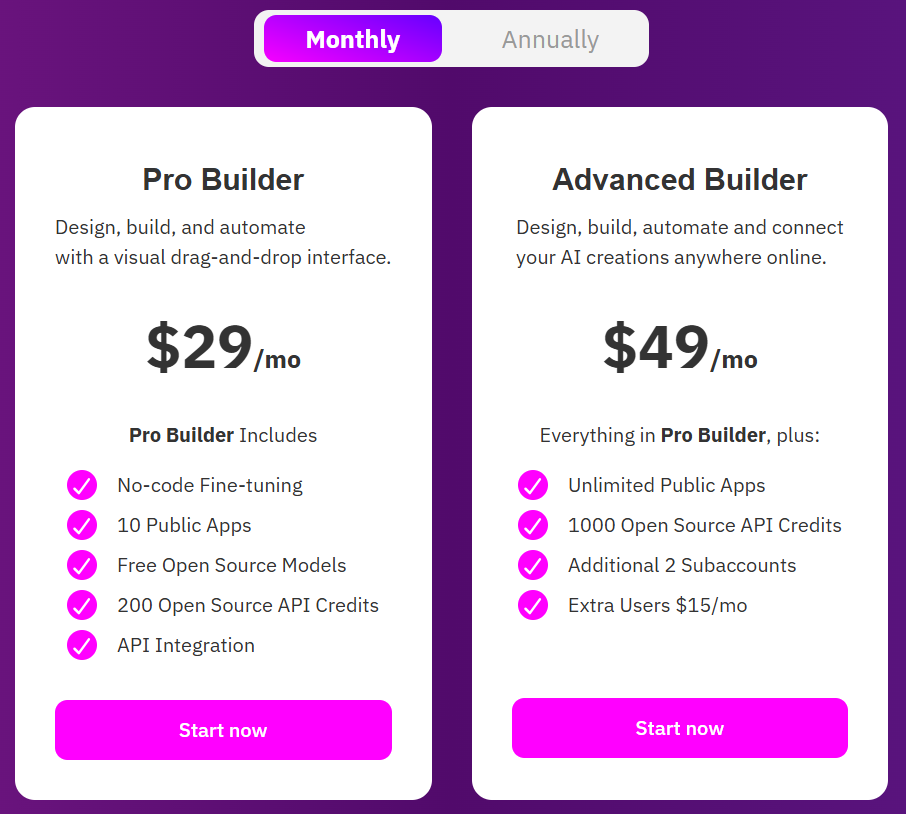
Pros and Cons
| Pros | Cons |
| No-code interface simplifies AI development. | Limited customization for advanced developers. |
| Access to a wide range of LLMs. | It may not suit enterprises requiring on-premise solutions. |
| Real-time experimentation accelerates development. | Some learning curve for non-technical users. |
| Extensive integration options enhance workflow compatibility. | Advanced features may require higher-tier plans. |
| Human feedback loop improves AI accuracy over time. |
How It Stacks Up Against Alternatives
1. Takomo.ai
Overview: A no-code AI builder focusing on combining different AI models effortlessly.
Strengths: User-friendly interface and versatility.
Limitations: Less emphasis on real-time experimentation and human feedback loops.
2. Cubeo AI
Overview: No-code platform for building custom AI Assistants and AI Teams.
Strengths: Allows users to create, train, and deploy AI agents using various data sources.
Limitations: May require more technical knowledge compared to Riku.ai.
3. Vertex AI Agent Builder
Overview: Empowers developers to design and deploy advanced generative AI applications.
Strengths: Supports both no-code and code-driven development.
Limitations: Geared more towards developers; may be complex for non-technical users.
IBR’s Review
Our Verdict: ⭐️⭐️⭐️⭐️☆
If you’re a startup founder, marketer, or educator seeking to integrate AI into your operations without the complexities of coding, Riku.ai is a compelling choice. Its intuitive interface, extensive integrations, and real-time experimentation capabilities make it a valuable tool for businesses aiming to leverage AI efficiently.
While it may not cater to the needs of advanced developers or enterprises requiring on-premise solutions, Riku.ai excels in democratizing AI for a broader audience.
If you’re exploring tools in the AI space, you may also find it helpful to check out how learning-based platforms like Fast.ai’s Deep Learning Course are equipping founders with the foundational knowledge to better understand tools like this.
Ready to revolutionize your business with AI?
Explore Riku.ai and discover how no-code AI development can streamline your operations and drive innovation.