Raising funds following a successful investor pitch is definitely a big milestone for any entrepreneur but it is only the first step to success. Investors want their money back along with profit. So even though the entrepreneur is the owner (major equity holder, mostly) of the business and is building the business with sweat and hard work, the entrepreneur is still bound by the obligation to return investors their money with profit.
You may be thinking – “That’s nothing new! I knew it already…What are you trying to pull off here?”
Well, let us give you some perspective, straight from Harvard Business Review. As per them,
“Two third of them (startups) never deliver a positive return to investors”.
Yes, which means that nearly 66% startups struggle to give any return to their investors.
Sounds disappointing?
We don’t mean to put a damper on your ‘Just Funded’ party. Rather in this Review, we discuss a 5-step guideline that you should follow once you have raised funds for your startup to make your business grow.
1. Stick to Your Plan – Focus is the KEY
We believe that if you have approached investors and managed to raise a fund, that means you have a plan for how to use that money for your business. The plan may be to set up an office space to run operations, acquire tech stuff, hire people, set up a production unit, and so on. So, once you are successful in raising those funds, stay true to your plan. Don’t get distracted by overthinking, doubt, or any other kind of diversion. Let us give an example,
“I am here to build something for the long term, anything else is a distraction”.
Mark Zuckerberg
Zuckerberg was offered 1 billion dollars by Yahoo to sell off Facebook in 2006. At that time Facebook was just a $20 million company with around 8 to 9 million subscribers. Many would have taken this huge amount and spent the rest of their life in some beach house in Hawaii.
But Zuckerberg refused the offer!
Why?
Read the quote again.
He had a vision and plan for his company, and he trusted himself. Always trust your plan, more so when you have raised investment. Investors are not stupid. When they invest in your company, they are thoroughly convinced of the roadmap that you have laid down for the future of the company. They of course may have suggestions about how to get better results. But the very fact that they have put their money on you, means that they trust you and your vision.
And on your part, you must have way more trust on your plan than your investors. Let’s take the example of CoatChex (now known as Chexology).
The initial idea of this business was to develop computerized coat check service for bars, nightclubs, and other nightlife industry businesses. Founder Derek Pacque appeared in Shark Tank and was offered $2 million for a whopping 33% stake by Mark Cuban. The stake was quite high, hence Pacque proposed a counteroffer of 20% stake, which Cuban declined. Finally, Pacque did not accept Cuban’s offer and walked out empty handed. Pacque’s decision shows two things: first, he didn’t want to give up a significant amount of control to others which may hinder the vision and direction of his company; and second, he was so confident about the credibility of his plan that he knew turning down one offer (even if it is from a Shark) would not compromise the future. And that is what happened: CoatChex is now a $7 million company with some heavyweight names, such as Nike, LiveNation, House of Blues, etc., as their clients.
2. Business is Team Game – Hire INTELLIGENTLY
“The secret of my success is that we have gone to exceptional lengths to hire the best people in the world”.
Steve Jobs
Hiring the right people is extremely important and definitely something to consider after securing funds. But whom should you hire? Often the answer is – skilled people. But skill is not enough, rather it is about hiring people that are a good fit for the organization. And by good fit we mean:

a. People Aligned to Your Vision
People who are aligned with the vision and mission of the organization are the kind of people you need on your side. Simon Sinek has rightly said that “when people are financially invested, they want a return, and when people are emotionally invested, they want to contribute”. These words are very insightful and should be kept in mind when you are hiring human resources for your business.
b. People Who are Versatile
All companies need efficient teams to run, and the more versatile that team is, the greater your chances of success will be. Many times, having multiple talents or skills is considered being versatile, but in the startup environment versatility goes far beyond a person’s skill set.
It calls for a mentality – a mentality to quickly adapt to changes which is essential for startups in today’s rapidly changing market; a mentality to take on problems with a positive frame of mind and deliver innovative ideas to solve the problem; and a mentality to work as a team with outstanding collaboration.
c. Quality of People and Not Quantity
Startups frequently hire too quickly after securing funds. But instead of joining this hiring spree, we suggest setting up an optimum approach of ‘how, when and who’ to save the company from being burdened with unfit resources. Though the ‘how, when and who’ of hiring can be very subjective for businesses, a small, motivated, and highly efficient team is any day better than a heavy, slow and demoralized team.
The reason is simple- a small but efficient team will coordinate their efforts for faster decision-making and a more streamlined workflow. Further, it is easier to get everyone on the same page and make decisions quickly with a smaller team. This can be a major advantage in fast-paced environments.
We can look at OpenAI to understand what a small but efficient team can do. OpenAI shook Google and challenged its supremacy by launching ChatGPT, an AI-powered chatbot. OpenAI’s small team of just 375 people has achieved amazing things in the arena of AI. They have created several successful AI models, including ChatGPT, GPT-3.5, DALL-E, Codex, and MuseNet. This is a testament to the talent and dedication of the OpenAI team, and it shows that great things can be accomplished with a small but focused group of people.
In contrast, a heavy, slow, and demoralized team is likely to be less productive and less successful. This is because demoralized team members are less likely to be motivated to do their best work. They may also be more likely to make mistakes and have conflicts with each other.
However, keep in mind that other than building a strong efficient team, outsourcing can also be a fantastic way to handle non-core work, particularly in times of rapid growth.
3. Don’t waste Your Money, Spend FRUGALLY
“Rule No.1:
Warren Buffet
Never Lose Money;
Rule No.2:
Don’t Forget Rule No.1”
If you deliberately slit your wrist, you will experience profuse bleeding that may endanger your life. Similarly, if you drain your money with unnecessary expenses, you will soon find your business in troubled water. Money is the blood supply of your business, and you have to maintain an optimized financial management strategy to always stay above the red line.
No matter how passionate you are or how brilliant your idea is, cash flow is what keeps the business going. You need to pay your employees, uphold running costs, and spend on equipment and utilities. Some business owners don’t maintain track of their finances, which makes them vulnerable in times of turmoil. The founders of companies that receive funding from investors should be well aware of the indicator they must evaluate to benchmark investment operations.
4. Your Product is Your Identity – Produce QUALITY
“Quality in a Service or Product is Not What You Put into It, It’s What the Customer Gets Out of It.”
Peter Drucker
A quality product is the key to making your product distinguished and the first choice of the customers. In today’s competitive market, you need to work continuously to improve the quality of your product to ensure that it serves the needs of others.
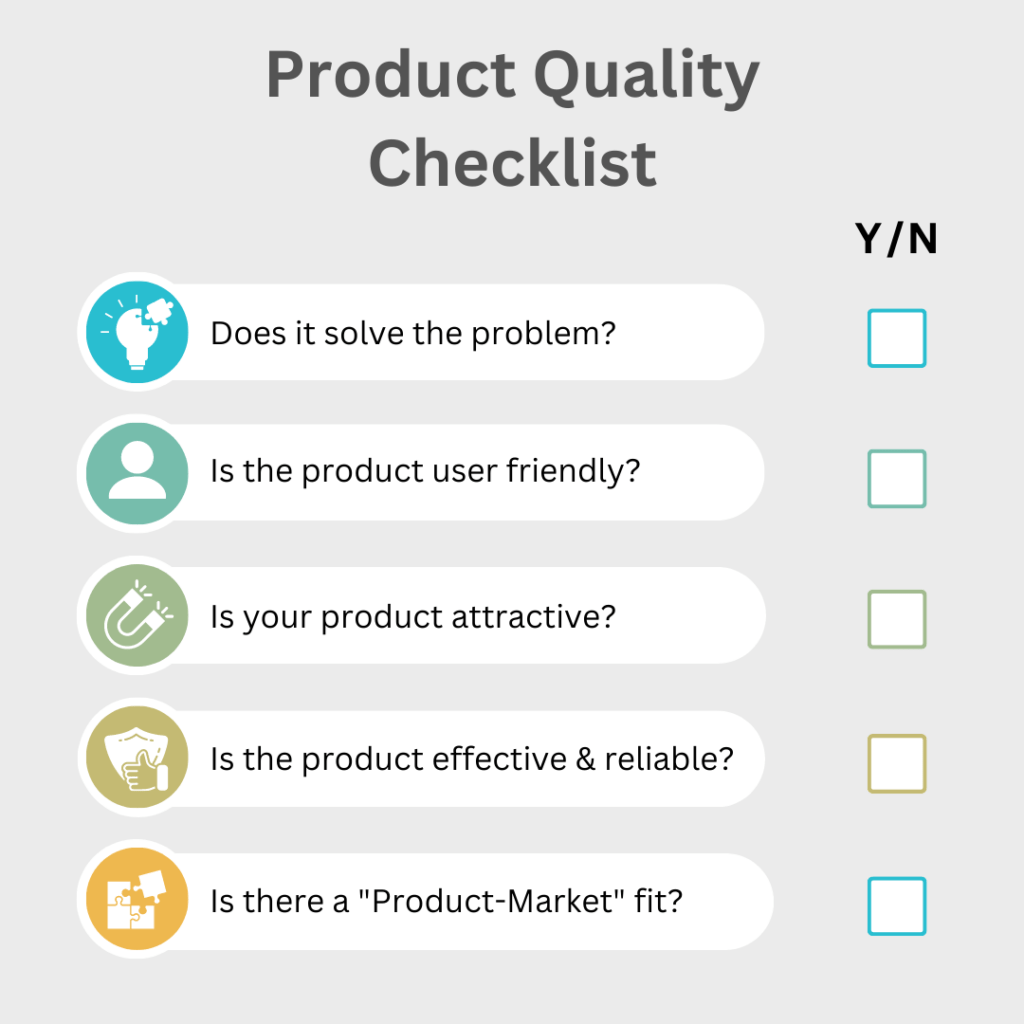
Use the following 5 parameters to evaluate if your product is putting quality first:
- First, it should be able to effectively solve a problem or a pain point of customers;
- Second, it should be user friendly, and the onboarding should also be easy and smooth;
- Third, it should be attractive by look;
- Fourth, and most importantly it should be effective and reliable, and
- Fifth, it should be a product-market fit, therefore, able to provide a unique experience to people.
In order to satisfy your clients, and ensure their loyalty and support, you need to present them with a quality product. Customers will immediately hunt for alternatives if you don’t live up to their expectations. Quality goods lower the risk and expense of having to replace faulty items. By becoming accredited with a recognized quality standard, businesses can establish a reputation for quality. Also, an essential part of a quality product is awesome customer service. Customers prefer to be heard and when they see that you are receptive, solve grievances quickly and improve your product from their inputs, they rest their faith on you.
5. Streamline Your Business, Develop STRATEGIES
“Marketing Strategy is a series of Integrated Actions Leading to a Sustainable competitive advantage.”
John Sculley
There is a sea of risks between your business and success. Competitors, recession, sales downturn, marketing failures and many other unprecedented events are waiting out there to put a hole in your ship. But the savior is here too, it’s called the strategy(s). Strategies are like a road map with specific milestones that guides your actions for measurable outcomes within a stipulated time period.
With a strategy in hand, you will never get off the course, because a good strategy has multiple waypoints before reaching the destination which acts as your progress checklist. To sail a business towards success without hitting any ‘risk-berg’ you need to develop strategies for every section of your business – be it sales, marketing, or resource management. But here you have to remember that strategies are subject to change depending on the circumstances.
For example, your regular resource management strategy may not be any good in times of economic downturn.
Point is, to be adaptable and open minded with the strategies and make necessary adjustments or complete refinement whenever needed.
Conclusion
So, let us congratulate you for your successful pitch, and wind up here. What we learned is don’t get sidetracked and stick to your plan, hire right people who are passionate and skilled at the same time, spend every dollar with long-term goals in mind, make your product/service the best it can be, and develop sound strategy(s) to stay on track and avoid costly mistakes.
That’s all from us, we would like to know very much what you think about our ideas, or what more can be done in this regard.
Feel free to use our comment section.